
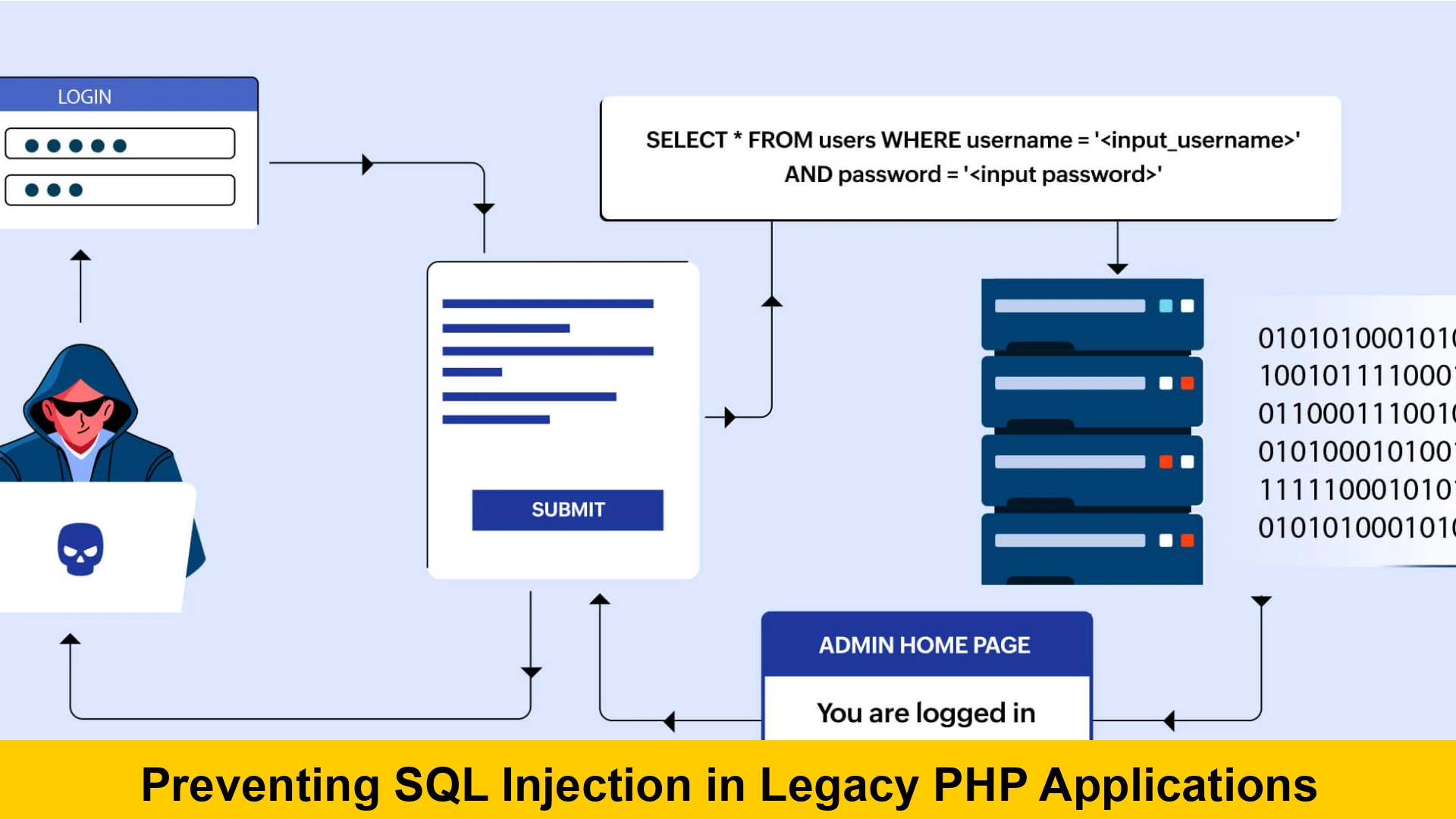
In the vast and ever-evolving landscape of web development, legacy PHP applications often stand as formidable challenges. While modern frameworks offer built-in protections and best practices, older systems, sometimes decades old, frequently grapple with fundamental security vulnerabilities. Among these, SQL Injection remains one of the most critical and pervasive threats. This guide delves deep into the strategies and techniques for preventing SQL injection in legacy PHP applications, providing practical steps and considerations for developers tasked with securing these venerable systems.
SQL Injection (SQLi) is a code injection technique used to attack data-driven applications, in which malicious SQL statements are inserted into an entry field for execution (e.g., to dump database contents to the attacker). For legacy PHP applications, where code might predate robust security frameworks or where developers lacked awareness of best practices, the risk is significantly higher. These applications often rely on outdated `mysql_` functions, concatenation-based query building, and insufficient input validation, making them prime targets for attackers looking to exploit SQLi vulnerabilities. Our goal here is to equip you with the knowledge to identify, mitigate, and ultimately secure these critical systems.
Understanding the Unique Challenges of Securing Legacy PHP
Securing legacy PHP applications isn’t as simple as applying modern security patches or upgrading to the latest framework version. These systems come with a unique set of hurdles:
- Outdated PHP Versions: Many legacy applications run on PHP versions that are no longer supported, meaning they don’t receive security updates. This inherently introduces vulnerabilities beyond just SQLi.
- Reliance on Deprecated Functions: The notorious `mysql_` functions are a common sight in old PHP codebases. These functions lack native support for prepared statements, forcing developers into less secure practices like manual escaping, which is often error-prone.
- Spaghetti Code and Lack of Documentation: Complex, poorly structured codebases without adequate documentation make it difficult to understand data flow and identify potential injection points.
- Limited Budget and Resources: Organizations often postpone security overhauls due to perceived high costs, time commitment, or lack of specialized personnel with expertise in older systems.
- Fear of Breaking Functionality: Modifying core functionalities in a legacy system, especially one without comprehensive test suites, carries a significant risk of introducing new bugs or breaking existing features.
- Inconsistent Coding Standards: Over the years, multiple developers might have worked on the application, leading to varying coding styles and security awareness, making it hard to apply a consistent security strategy.
Despite these challenges, fixing SQL injection in old PHP is not an insurmountable task. It requires a systematic approach, patience, and a deep understanding of the attack vector.
The Cornerstone of Prevention: Parameterized Queries (Prepared Statements)
The single most effective method for preventing SQL injection in legacy PHP applications, and indeed in any application, is the use of parameterized queries, often referred to as prepared statements. This technique separates the SQL code from the data, ensuring that user input is treated purely as data and never as executable code. When you use prepared statements, the database engine compiles the query structure first, and then binds the data values to it. This means malicious SQL fragments in the input cannot alter the query’s logic.
Implementing Prepared Statements with PDO and MySQLi
Modern PHP offers two primary extensions for database interaction that support prepared statements: PDO (PHP Data Objects) and MySQLi (MySQL Improved Extension). If your legacy PHP application is running on PHP 5.1 or newer, you likely have access to these. The effort to refactor existing `mysql_` calls to PDO or MySQLi will pay dividends in security.
Using PDO for Prepared Statements
PDO offers a consistent interface for accessing various databases. It’s often recommended for its flexibility and feature set. Here’s a basic example of how to migrate a vulnerable query:
Vulnerable `mysql_` Example:
$username = $_POST['username'];
$password = $_POST['password'];
$query = "SELECT  FROM users WHERE username='" . mysql_real_escape_string($username) . "' AND password='" . mysql_real_escape_string($password) . "'";
$result = mysql_query($query);
// ... process result ...
Even with `mysql_real_escape_string()`, this approach is inherently risky because it relies on the developer remembering to escape every input in every query. A single forgotten escape can lead to a critical vulnerability.
Secure PDO Example:
$dbHost = 'localhost';
$dbName = 'mydatabase';
$dbUser = 'dbuser';
$dbPass = 'dbpass';

try {
    $pdo = new PDO("mysql:host=$dbHost;dbname=$dbName;charset=utf8mb4", $dbUser, $dbPass);
    $pdo->setAttribute(PDO::ATTR_ERRMODE, PDO::ERRMODE_EXCEPTION);
    $pdo->setAttribute(PDO::ATTR_EMULATE_PREPARES, false); // Crucial for real prepared statements
} catch (PDOException $e) {
    die("DB Connection Error: " . $e->getMessage());
}

$username = $_POST['username'];
$password = $_POST['password'];

$stmt = $pdo->prepare("SELECT  FROM users WHERE username = :username AND password = :password");
$stmt->bindParam(':username', $username, PDO::PARAM_STR);
$stmt->bindParam(':password', $password, PDO::PARAM_STR);
$stmt->execute();

$user = $stmt->fetch(PDO::FETCH_ASSOC);
if ($user) {
    // User found, login successful
} else {
    // Invalid credentials
}
In this PDO example, `bindParam` ensures that `$username` and `$password` are treated as literal strings and not parts of the SQL command. The `PDO::ATTR_EMULATE_PREPARES, false` setting is vital as it forces the database to perform real prepared statements, rather than emulating them in PHP, which can sometimes reintroduce vulnerabilities.
Using MySQLi for Prepared Statements
MySQLi is specifically designed for MySQL databases and can offer slightly better performance for MySQL-only applications. The implementation of prepared statements is similar:
Secure MySQLi Example:
$mysqli = new mysqli("localhost", "dbuser", "dbpass", "mydatabase");

if ($mysqli->connect_errno) {
    die("Failed to connect to MySQL: " . $mysqli->connect_error);
}

$username = $_POST['username'];
$password = $_POST['password'];

// Create a prepared statement
$stmt = $mysqli->prepare("SELECT  FROM users WHERE username = ? AND password = ?");

// Bind parameters
$stmt->bind_param("ss", $username, $password); // "ss" indicates two string parameters

// Execute the statement
$stmt->execute();

// Get results
$result = $stmt->get_result();
if ($result->num_rows > 0) {
    $user = $result->fetch_assoc();
    // User found
} else {
    // Invalid credentials
}

$stmt->close();
$mysqli->close();
The `bind_param` method in MySQLi is powerful, requiring you to specify the type of data being bound (s for string, i for integer, d for double, b for blob). This explicit typing adds another layer of security, making it a robust method for sql injection prevention techniques.
Beyond Prepared Statements: Comprehensive Security Measures
While prepared statements are paramount, securing legacy PHP applications requires a multi-layered approach. No single defense is foolproof.
1. Input Validation and Sanitization
All user input should be rigorously validated and sanitized at the server-side, regardless of whether you’re using prepared statements. This involves checking data types, length, format, and permissible characters.
- Whitelist Validation: The most secure approach is to define what is allowed, rather than trying to filter out what isn’t. For example, if a field should contain only numbers, reject anything that isn’t a number.
- Filter Functions: PHP’s `filter_var()` with appropriate filters (e.g., `FILTER_VALIDATE_INT`, `FILTER_VALIDATE_EMAIL`, `FILTER_SANITIZE_STRING` – though be cautious with sanitization for display vs. database input) can be very useful.
- Regular Expressions: For complex patterns like usernames or file names, regular expressions can enforce strict formatting rules.
This is a fundamental aspect of PHP security best practices, ensuring that malformed or malicious data never even reaches the database query construction stage.
2. Escaping Output for Display (XSS Prevention)
While not directly related to SQL injection, proper output escaping is critical for preventing Cross-Site Scripting (XSS) attacks, which often go hand-in-hand with inadequate input handling. Always escape data just before it’s displayed in the browser using functions like `htmlspecialchars()` or `htmlentities()`. This ensures that any user-supplied content is rendered as plain text and not as executable HTML or JavaScript.
3. Principle of Least Privilege for Database Users
Database users should only have the minimum necessary permissions required for their specific tasks. A web application user should generally:
- Only have `SELECT`, `INSERT`, `UPDATE`, `DELETE` permissions on the tables it needs to access.
- Never have `GRANT`, `DROP`, `ALTER`, `CREATE`, or `TRUNCATE` permissions.
- Not be able to execute stored procedures that grant higher privileges.
- Not have `FILE` privileges (for reading/writing files on the server).
This significantly limits the damage an attacker can inflict even if they manage to achieve a successful SQL injection, making it a crucial aspect of sql injection protection for php applications.
4. Deprecating and Replacing `mysql_` Functions
The `mysql_` extension has been deprecated since PHP 5.5.0 and removed in PHP 7.0.0. If your legacy application still uses these functions, it’s a huge red flag indicating severe security and maintenance risks. The immediate goal should be to migrate away from them. Even if a full rewrite is not feasible, incrementally replacing `mysql_` calls with PDO or MySQLi prepared statements is the most impactful step you can take. This directly addresses the best way to prevent sql injection in php within older code.
5. Error Reporting and Logging
Configure PHP and your database to prevent displaying sensitive error messages to users. Detailed error messages can inadvertently provide attackers with valuable information about your database structure, query logic, and application paths. Instead, log errors internally for developers to review. Use `error_reporting(0)` in production environments, and log errors to a secure file. Monitoring these logs can also help identify potential attack attempts.
6. Web Application Firewall (WAF)
A Web Application Firewall (WAF) can act as a crucial outer layer of defense for preventing SQL injection in outdated PHP code. A WAF sits in front of your application and inspects incoming HTTP traffic, blocking malicious requests before they reach your server. While not a substitute for secure coding, a WAF can provide immediate protection against known attack patterns, give you time to implement code-level fixes, and even detect zero-day vulnerabilities. Many hosting providers offer WAF solutions, or you can implement open-source options like ModSecurity.
7. Regular Code Audits and Security Reviews
For legacy applications, regular and thorough code review is indispensable. Manual inspection can uncover logic flaws and forgotten security measures that automated tools might miss. Focus on:
- Database Interactions: Every point where user input interacts with the database is a potential injection vector.
- Input Handling: Review how all `$_GET`, `$_POST`, `$_REQUEST`, `$_COOKIE`, and `$_SERVER` variables are processed.
- Error Handling: Ensure sensitive error details are not exposed.
Regular security audits, ideally by independent security experts, can identify vulnerabilities and offer guidance on common sql injection prevention methods php applications should employ.
A Step-by-Step Guide to Fixing SQL Injection Vulnerabilities in Legacy PHP
Addressing SQL injection in existing, vulnerable applications can seem overwhelming. Here’s a structured approach to guide your efforts:
Step 1: Inventory and Assessment
Begin by creating a comprehensive inventory of all database interactions within your application. Identify:
- All files and functions that execute SQL queries.
- All input sources (`$_GET`, `$_POST`, `$_REQUEST`, `$_COOKIE`, file uploads, etc.) that feed into these queries.
- Which PHP database extension is being used (`mysql_*`, PDO, MySQLi).
- Which tables and columns are accessed by which queries.
Tools like static analysis security testing (SAST) or dynamic analysis security testing (DAST) can help pinpoint potential vulnerabilities, providing initial steps to fix sql injection vulnerabilities php may contain.
Step 2: Prioritize Critical Areas
Not all SQL injection points are equally dangerous. Prioritize based on:
- Exposure: Publicly accessible pages are higher priority than internal admin tools (though both are important).
- Impact: Queries that delete data, alter privileges, or access sensitive information (e.g., user credentials, financial data) should be addressed first.
- Feasibility: Start with simpler fixes to gain momentum and demonstrate progress.
Step 3: Implement Prepared Statements Incrementally
For many legacy applications, a full rewrite is not an option. Instead, focus on incrementally refactoring vulnerable queries:
- Start with `INSERT` and `UPDATE` statements: These often involve direct user input and are critical for data integrity.
- Move to `SELECT` statements with `WHERE` clauses: These are common targets for data exfiltration.
- Address dynamic queries: Queries with dynamic `ORDER BY` or `LIMIT` clauses require careful handling (e.g., validating column names against a whitelist before concatenating).
Remember to transition from `mysql_real_escape_string()` to parameterized queries. This is the guide to securing legacy php web apps against the most common SQLi attacks.
Step 4: Enhance Input Validation
As you refactor, strengthen input validation routines. Create reusable functions or classes for common validation patterns. For example, a function `validate_int($input)` that returns a filtered integer or `false` on failure, or `validate_email($input)`.
Step 5: Apply Least Privilege
Review and restrict database user permissions. If your application currently uses a single, highly privileged database user, create specific users with granular permissions for different application modules or functionalities. This helps in how to prevent sql injection attacks on old php by limiting potential damage.
Step 6: Implement and Test
After implementing fixes, rigorously test the application. Manual testing, penetration testing, and automated security scans should be employed. Since legacy apps often lack automated tests, this manual step is crucial to ensure functionality remains intact and new vulnerabilities aren’t introduced. Pay close attention to edge cases and unexpected inputs.
Step 7: Ongoing Monitoring and Maintenance
Security is not a one-time fix. Regularly monitor application and database logs for suspicious activity. Keep an eye on new security advisories related to PHP, your database, and any third-party libraries. Schedule periodic security reviews and maintain a culture of security within your development team.
Long-Term Strategy: Modernizing Legacy PHP Applications
While the focus here is on immediate sql injection prevention techniques for legacy PHP, the ultimate goal should be modernizing legacy PHP applications. This could involve:
- Upgrading PHP Version: Migrating to a supported PHP version (PHP 8.x) provides access to performance improvements, new features, and critical security updates.
- Adopting a Modern Framework: Gradually integrating components from modern PHP frameworks like Laravel or Symfony can introduce robust ORMs (Object-Relational Mappers), built-in security features, and better code organization.
- Refactoring Code: Breaking down monolithic legacy code into smaller, more manageable modules or microservices.
- Implementing Automated Testing: Building a comprehensive suite of unit, integration, and end-to-end tests ensures code stability and makes future security patches safer.
These strategic moves, while significant investments, offer the most comprehensive and sustainable solution for securing legacy PHP applications against SQL injection and a host of other vulnerabilities in the long run.
Essential Tools and Resources for Legacy PHP Security
To aid in your mission of preventing SQL injection in legacy PHP applications, consider leveraging these tools and resources:
- OWASP SQL Injection Prevention Cheat Sheet: An authoritative guide detailing prevention techniques across various languages and platforms. (https://cheatsheetseries.owasp.org/cheatsheets/SQL_Injection_Prevention_Cheat_Sheet.html)
- PHP Manual (PDO/MySQLi): The official documentation for PHP’s database extensions, providing examples and best practices for prepared statements. (https://www.php.net/manual/en/book.pdo.php)
- PortSwigger Web Security Academy: Offers interactive labs and comprehensive guides on SQL injection and other web vulnerabilities. An excellent resource for understanding attack vectors and defense mechanisms. (https://portswigger.net/web-security/sql-injection)
- Static Analysis Tools: Tools like PHPStan, Psalm, or even commercial SAST solutions can help identify potential issues in code without executing it.
- Dynamic Analysis Tools: Web vulnerability scanners (e.g., OWASP ZAP, Burp Suite) can actively probe your application for SQL injection and other vulnerabilities.
Conclusion
SQL Injection remains a formidable adversary, especially when dealing with legacy PHP applications. However, by adopting a meticulous and multi-pronged approach, developers can significantly reduce the risk. The core strategy revolves around embracing parameterized queries via PDO or MySQLi, combined with robust input validation, least privilege database access, and continuous security auditing. While the journey to preventing SQL injection in legacy PHP applications might be challenging, the security and stability it brings to your critical systems are invaluable. Prioritize these security fixes, educate your team on php security best practices, and embark on a path towards a more secure and maintainable future for your legacy web applications. Protecting against SQLi is not just about patching a vulnerability; it’s about safeguarding your data, your users, and your organization’s reputation.