
In the modern web, JSON (JavaScript Object Notation) has become the de facto standard for data exchange between servers and clients, as well as between different services. Its human-readable format and simplicity make it incredibly popular. However, simply receiving a JSON payload isn’t enough; robust applications must validate this data to ensure its integrity, prevent errors, and safeguard against security vulnerabilities. This challenge becomes particularly pronounced when dealing with nested JSON payloads, where data structures can be complex and deeply embedded. Ignoring proper validation can lead to unexpected application behavior, security breaches, and a frustrating user experience.
This comprehensive guide will walk you through various strategies and best practices for how to validate nested JSON payloads in PHP. We’ll start with fundamental PHP functions, progress to manual validation techniques for complex structures, explore recursive methods, and finally, delve into powerful third-party libraries that leverage JSON Schema for professional-grade validation. By the end of this article, you’ll have a solid understanding of how to implement resilient and efficient PHP JSON data validation in your applications, ensuring that every piece of data conforms to your expectations.
Whether you’re building a REST API, processing webhook notifications, or simply handling client-side submissions, the principles outlined here will equip you to validate complex JSON PHP structures effectively. We’ll cover everything from basic type checking to intricate structural validation, giving you the tools to confidently handle any JSON data thrown your way. Let’s dive in and master the art of validating nested JSON in PHP.
Understanding JSON and the Need for Validation in PHP
JSON is a lightweight, language-independent data-interchange format. It’s built on two structures: a collection of name/value pairs (like a PHP associative array or object) and an ordered list of values (like a PHP indexed array). This simplicity is its strength, but also where the need for validation arises. When your PHP application receives a JSON payload, it might be:
- Malformed or invalid JSON string.
- Missing expected fields.
- Containing fields with incorrect data types.
- Having extra, unexpected fields.
- Presenting nested structures that don’t match your schema.
Any of these issues can cause your application to malfunction, throw exceptions, or even expose it to malicious input. Therefore, validating the incoming JSON payload is a critical step in building reliable and secure PHP applications. Especially when you need to handle nested JSON PHP, the complexity increases significantly, demanding more sophisticated validation strategies.
Imagine an e-commerce order payload. It might contain customer details, shipping address, an array of items (each with its own ID, quantity, price), and payment information. If the ‘shipping address’ object is missing a ‘zip code’, or an ‘item’ has a non-numeric ‘quantity’, your application’s logic for processing the order could break. This is precisely why a robust approach to json payload validation php is indispensable.
Initial Steps: Decoding JSON and Basic Error Checking
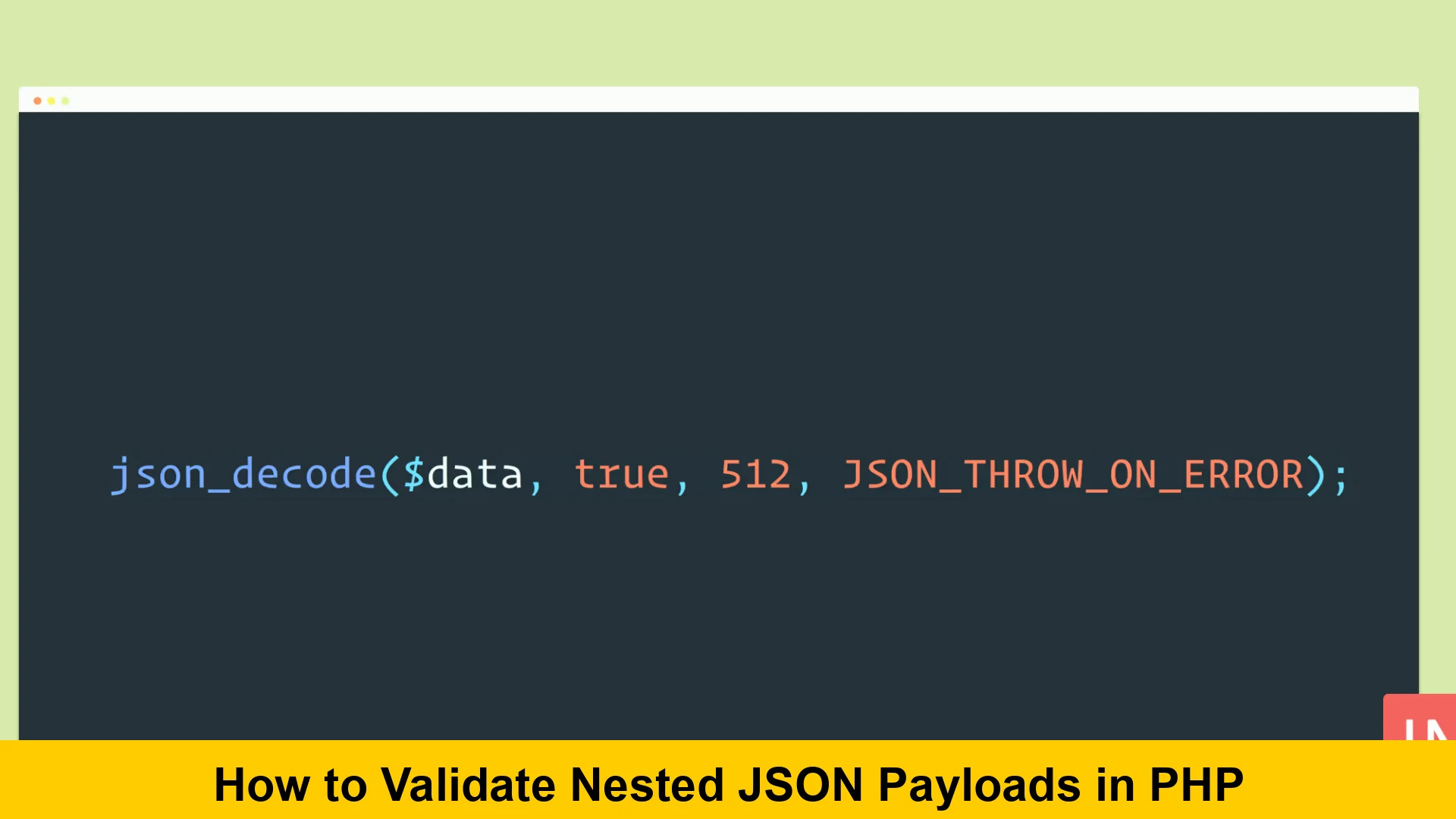
Before you can validate the content of a JSON payload, you first need to decode it into a PHP data structure. PHP provides the built-in json_decode() function for this purpose. It’s crucial to always check for decoding errors immediately after calling this function. This is your first line of defense against malformed JSON.
<?php
$jsonString = '{ "user": { "id": 123, "name": "John Doe", "address": { "street": "123 Main St", "city": "Anytown" } }, "items": [ { "itemId": "A1", "qty": 2 }, { "itemId": "B2", "qty": "one" } ] }';

// A slightly malformed JSON string for demonstration
// $malformedJsonString = '{ "user": { "id": 123, "name": "John Doe", "address": { "street": "123 Main St", "city": "Anytown" } , "items": [ { "itemId": "A1", "qty": 2 }, { "itemId": "B2", "qty": "one" } ] }'; // Missing closing bracket for user

$data = json_decode($jsonString, true); // true for associative array

if (json_last_error() !== JSON_ERROR_NONE) {
    echo "JSON Decode Error: " . json_last_error_msg();
    // Handle the error, e.g., return a 400 Bad Request response
    exit();
}

// Now $data contains the decoded associative array
print_r($data);
?>
The json_decode() function returns null on error, but it’s more reliable to use json_last_error() and json_last_error_msg() to get specific error details. This fundamental check ensures that at least the structure of the JSON string is syntactically correct. However, it doesn’t tell you anything about the data types or presence of expected fields within that structure. This is where how to validate deeply nested JSON structures with PHP truly begins.
Manual Validation Techniques for Nested JSON
For simpler nested JSON structures or when you have very specific, custom validation rules, manual validation using standard PHP constructs like isset(), empty(), is_array(), is_string(), etc., can be effective. This approach gives you granular control but can become verbose and difficult to maintain for complex payloads. It’s a great starting point for a beginner guide to validating nested JSON in PHP.
Validating Top-Level and Shallowly Nested Fields
Let’s consider a simple user registration payload:
{
    "username": "johndoe",
    "email": "[email protected]",
    "password": "secure_password_123",
    "profile": {
        "firstName": "John",
        "lastName": "Doe",
        "age": 30
    }
}
Here’s how you might manually validate this using PHP:
<?php
function validateUserPayload(array $data): array
{
    $errors = [];

    // Validate top-level fields
    if (empty($data['username']) || !is_string($data['username'])) {
        $errors['username'] = 'Username is required and must be a string.';
    }
    if (empty($data['email']) || !filter_var($data['email'], FILTER_VALIDATE_EMAIL)) {
        $errors['email'] = 'Email is required and must be a valid email address.';
    }
    if (empty($data['password']) || !is_string($data['password']) || strlen($data['password']) < 8) {
        $errors['password'] = 'Password is required, must be a string, and at least 8 characters long.';
    }

    // Validate nested 'profile' object
    if (!isset($data['profile']) || !is_array($data['profile'])) {
        $errors['profile'] = 'Profile information is required and must be an object.';
    } else {
        $profile = $data['profile'];
        if (empty($profile['firstName']) || !is_string($profile['firstName'])) {
            $errors['profile.firstName'] = 'First name is required and must be a string.';
        }
        if (empty($profile['lastName']) || !is_string($profile['lastName'])) {
            $errors['profile.lastName'] = 'Last name is required and must be a string.';
        }
        if (!isset($profile['age']) || !is_int($profile['age']) || $profile['age'] < 18) {
            $errors['profile.age'] = 'Age is required, must be an integer, and at least 18.';
        }
    }

    return $errors;
}

$validPayload = json_decode('{
    "username": "johndoe",
    "email": "[email protected]",
    "password": "secure_password_123",
    "profile": {
        "firstName": "John",
        "lastName": "Doe",
        "age": 30
    }
}', true);

$invalidPayload = json_decode('{
    "username": "",
    "email": "invalid-email",
    "profile": {
        "firstName": "",
        "age": "twenty"
    }
}', true);

echo "<h3>Valid Payload Validation:</h3>";
$validErrors = validateUserPayload($validPayload);
if (empty($validErrors)) {
    echo "Payload is valid!n";
} else {
    print_r($validErrors);
}

echo "<h3>Invalid Payload Validation:</h3>";
$invalidErrors = validateUserPayload($invalidPayload);
if (empty($invalidErrors)) {
    echo "Payload is valid!n";
} else {
    print_r($invalidErrors);
}
?>
This approach manually checks each field. While feasible for shallow nesting, it quickly becomes cumbersome for deeply nested or highly dynamic structures. For a more generic solution, especially when dealing with data that may or may not be present, consider exploring a comprehensive guide to PHP error handling to manage potential validation failures gracefully.
Recursive Validation for Deeply Nested Structures
When your JSON can have arbitrary levels of nesting or contains arrays of objects, a recursive validation function is often the most practical manual approach. This allows you to define a set of rules that can be applied to any level of the structure. This is an easy way to validate JSON data in PHP applications if you prefer to avoid external libraries for simpler cases.
Consider a product catalog entry with variants and nested pricing tiers:
{
    "product_id": "PROD001",
    "name": "Premium Widget",
    "variants": [
        {
            "sku": "PW001-S",
            "color": "Red",
            "size": "Small",
            "price_info": {
                "base_price": 10.99,
                "currency": "USD"
            }
        },
        {
            "sku": "PW001-L",
            "color": "Blue",
            "size": "Large",
            "price_info": {
                "base_price": 12.99,
                "currency": "USD",
                "discount": 0.10
            }
        }
    ]
}
A recursive validator can iterate through arrays and objects, applying validation rules at each level. This is key for how to check JSON data integrity PHP in complex scenarios.
<?php
function validateProduct(array $product): array
{
    $errors = [];

    if (empty($product['product_id']) || !is_string($product['product_id'])) {
        $errors['product_id'] = 'Product ID is required and must be a string.';
    }
    if (empty($product['name']) || !is_string($product['name'])) {
        $errors['name'] = 'Product name is required and must be a string.';
    }

    if (!isset($product['variants']) || !is_array($product['variants'])) {
        $errors['variants'] = 'Product must have variants.';
    } else {
        foreach ($product['variants'] as $index => $variant) {
            $variantErrors = validateVariant($variant);
            if (!empty($variantErrors)) {
                $errors['variants'][$index] = $variantErrors;
            }
        }
    }

    return $errors;
}

function validateVariant(array $variant): array
{
    $errors = [];

    if (empty($variant['sku']) || !is_string($variant['sku'])) {
        $errors['sku'] = 'SKU is required and must be a string.';
    }
    if (empty($variant['color']) || !is_string($variant['color'])) {
        $errors['color'] = 'Color is required and must be a string.';
    }
    if (empty($variant['size']) || !is_string($variant['size'])) {
        $errors['size'] = 'Size is required and must be a string.';
    }

    if (!isset($variant['price_info']) || !is_array($variant['price_info'])) {
        $errors['price_info'] = 'Price information is required and must be an object.';
    } else {
        $priceInfoErrors = validatePriceInfo($variant['price_info']);
        if (!empty($priceInfoErrors)) {
            $errors['price_info'] = $priceInfoErrors;
        }
    }

    return $errors;
}

function validatePriceInfo(array $priceInfo): array
{
    $errors = [];

    if (!isset($priceInfo['base_price']) || !is_numeric($priceInfo['base_price']) || $priceInfo['base_price'] <= 0) {
        $errors['base_price'] = 'Base price is required, must be numeric, and greater than 0.';
    }
    if (empty($priceInfo['currency']) || !is_string($priceInfo['currency']) || strlen($priceInfo['currency']) !== 3) {
        $errors['currency'] = 'Currency is required, must be a 3-letter string (e.g., USD).';
    }
    // Discount is optional
    if (isset($priceInfo['discount'])) {
        if (!is_numeric($priceInfo['discount']) || $priceInfo['discount'] < 0 || $priceInfo['discount'] >= 1) {
            $errors['discount'] = 'Discount must be a numeric value between 0 and 1.';
        }
    }

    return $errors;
}

$validProductPayload = json_decode('{
    "product_id": "PROD001",
    "name": "Premium Widget",
    "variants": [
        {
            "sku": "PW001-S",
            "color": "Red",
            "size": "Small",
            "price_info": {
                "base_price": 10.99,
                "currency": "USD"
            }
        },
        {
            "sku": "PW001-L",
            "color": "Blue",
            "size": "Large",
            "price_info": {
                "base_price": 12.99,
                "currency": "USD",
                "discount": 0.10
            }
        }
    ]
}', true);

$invalidProductPayload = json_decode('{
    "product_id": "",
    "name": "",
    "variants": [
        {
            "sku": "PW001-S",
            "color": "Red",
            "size": "Small",
            "price_info": {
                "base_price": -5,
                "currency": "USD"
            }
        },
        {
            "sku": "",
            "color": "",
            "size": "",
            "price_info": {
                "base_price": 12.99,
                "currency": "US",
                "discount": 1.5
            }
        }
    ]
}', true);

echo "<h3>Valid Product Payload Validation:</h3>";
$validErrors = validateProduct($validProductPayload);
if (empty($validErrors)) {
    echo "Product payload is valid!n";
} else {
    print_r($validErrors);
}

echo "<h3>Invalid Product Payload Validation:</h3>";
$invalidErrors = validateProduct($invalidProductPayload);
if (empty($invalidErrors)) {
    echo "Product payload is valid!n";
} else {
    print_r($invalidErrors);
}
?>
This recursive approach provides better organization and reusability for validating sub-structures. However, it still requires you to manually define validation logic for each possible field and its expected type/format. For truly complex and dynamic schemas, or when working with external APIs that provide JSON schemas, this manual method quickly becomes unwieldy. This brings us to a more advanced and scalable solution: using JSON Schema and PHP validation libraries, representing some of the best practices for validating JSON payloads in PHP.
Leveraging JSON Schema with PHP Validation Libraries
For large-scale applications or when dealing with complex, evolving JSON structures, manually writing validation logic is prone to errors and difficult to maintain. A superior approach is to define your expected JSON structure using JSON Schema, a powerful standard for describing the structure and constraints of JSON data. Once you have a schema, you can use a PHP library to validate your incoming JSON payload against it.
What is JSON Schema?
JSON Schema is a vocabulary that allows you to annotate and validate JSON documents. It provides a formal way to specify:
- Required properties.
- Data types (string, number, boolean, array, object, null).
- String formats (e.g., email, date-time, regex).
- Numeric ranges (minimum, maximum).
- Array length and item types.
- Object property patterns.
- And much more.
The beauty of JSON Schema is that it’s declarative. You describe what the data should look like, not how to validate it. This separation of concerns makes your validation logic cleaner, more readable, and easier to manage, especially when you need to validate complex JSON PHP structures.
Introducing a PHP Validation Library for Nested JSON: justinrainbow/json-schema
One of the most popular and robust libraries for validating JSON against a JSON Schema in PHP is justinrainbow/json-schema. It’s easily installable via Composer. If you’re new to Composer, you might find our guide on setting up Composer for PHP projects helpful.
First, install the library:
composer require justinrainbow/json-schemaNext, let’s define a JSON Schema for our previous product example. This is an example of a php validation library for nested json in action.
{
    "$schema": "http://json-schema.org/draft-07/schema#",
    "title": "Product Schema",
    "description": "Schema for a product entry with variants",
    "type": "object",
    "required": ["product_id", "name", "variants"],
    "properties": {
        "product_id": {
            "type": "string",
            "pattern": "^[A-Z]{4}d{3}$",
            "description": "Unique product identifier"
        },
        "name": {
            "type": "string",
            "minLength": 3,
            "maxLength": 100
        },
        "variants": {
            "type": "array",
            "minItems": 1,
            "items": {
                "type": "object",
                "required": ["sku", "color", "size", "price_info"],
                "properties": {
                    "sku": {
                        "type": "string",
                        "pattern": "^[A-Z]{2}d{3}-[A-Z]{1}-d{1}$"
                    },
                    "color": {
                        "type": "string"
                    },
                    "size": {
                        "type": "string",
                        "enum": ["Small", "Medium", "Large", "X-Large"]
                    },
                    "price_info": {
                        "type": "object",
                        "required": ["base_price", "currency"],
                        "properties": {
                            "base_price": {
                                "type": "number",
                                "minimum": 0.01
                            },
                            "currency": {
                                "type": "string",
                                "pattern": "^[A-Z]{3}$"
                            },
                            "discount": {
                                "type": "number",
                                "minimum": 0,
                                "exclusiveMaximum": 1
                            }
                        },
                        "additionalProperties": false
                    }
                },
                "additionalProperties": false
            }
        }
    },
    "additionalProperties": false
}
Notice how expressive this schema is! It defines regular expressions for product_id and sku, enumerates allowed values for size, specifies numeric ranges for prices and discounts, and even forbids additional properties using "additionalProperties": false. This level of detail makes it very effective for validate complex json php schemas.
Now, let’s use the PHP library to validate a JSON payload against this schema:
<?php
require 'vendor/autoload.php';

use JsonSchemaValidator;

// The JSON payload to validate
$jsonPayloadString = '{
    "product_id": "PROD001",
    "name": "Premium Widget",
    "variants": [
        {
            "sku": "PW001-S",
            "color": "Red",
            "size": "Small",
            "price_info": {
                "base_price": 10.99,
                "currency": "USD"
            }
        },
        {
            "sku": "PW001-L",
            "color": "Blue",
            "size": "Large",
            "price_info": {
                "base_price": 12.99,
                "currency": "USD",
                "discount": 0.10
            }
        }
    ]
}';

// An invalid JSON payload for demonstration
$invalidJsonPayloadString = '{
    "product_id": "P001", // Invalid pattern
    "name": "Wid", // Too short
    "variants": [
        {
            "sku": "PW001-S",
            "color": "Red",
            "size": "Tiny", // Not in enum
            "price_info": {
                "base_price": -5,
                "currency": "USD"
            }
        },
        {
            "sku": "PW001-M-2", // Invalid pattern
            "color": "Green",
            "size": "Medium",
            "price_info": {
                "base_price": 15,
                "currency": "GBP",
                "discount": 1.1 // Greater than 1
            },
            "extra_field": "should not be here"
        }
    ]
}';

// Decode the JSON string into a PHP object (not associative array for this library)
$data = json_decode($jsonPayloadString);
if (json_last_error() !== JSON_ERROR_NONE) {
    die("JSON Decode Error: " . json_last_error_msg());
}

// Load the schema from a file or string
// For simplicity, we'll use the schema directly as a PHP object
$schemaString = '{
    "$schema": "http://json-schema.org/draft-07/schema#",
    "title": "Product Schema",
    "description": "Schema for a product entry with variants",
    "type": "object",
    "required": ["product_id", "name", "variants"],
    "properties": {
        "product_id": {
            "type": "string",
            "pattern": "^[A-Z]{4}\d{3}$",
            "description": "Unique product identifier"
        },
        "name": {
            "type": "string",
            "minLength": 3,
            "maxLength": 100
        },
        "variants": {
            "type": "array",
            "minItems": 1,
            "items": {
                "type": "object",
                "required": ["sku", "color", "size", "price_info"],
                "properties": {
                    "sku": {
                        "type": "string",
                        "pattern": "^[A-Z]{2}\d{3}-[A-Z]{1}-\d{1}$"
                    },
                    "color": {
                        "type": "string"
                    },
                    "size": {
                        "type": "string",
                        "enum": ["Small", "Medium", "Large", "X-Large"]
                    },
                    "price_info": {
                        "type": "object",
                        "required": ["base_price", "currency"],
                        "properties": {
                            "base_price": {
                                "type": "number",
                                "minimum": 0.01
                            },
                            "currency": {
                                "type": "string",
                                "pattern": "^[A-Z]{3}$"
                            },
                            "discount": {
                                "type": "number",
                                "minimum": 0,
                                "exclusiveMaximum": 1
                            }
                        },
                        "additionalProperties": false
                    }
                },
                "additionalProperties": false
            }
        }
    },
    "additionalProperties": false
}';
$schema = json_decode($schemaString);

// Create a Validator instance
$validator = new Validator();

echo "<h3>Valid Payload Validation with JSON Schema:</h3>";
$validator->validate($data, $schema);

if ($validator->isValid()) {
    echo "The JSON validates successfully.n";
} else {
    echo "JSON does not validate. Violations:n";
    foreach ($validator->getErrors() as $error) {
        echo sprintf("[%s] %sn", $error['property'], $error['message']);
    }
}

// Validate the invalid payload
$invalidData = json_decode($invalidJsonPayloadString);
if (json_last_error() !== JSON_ERROR_NONE) {
    die("JSON Decode Error for invalid payload: " . json_last_error_msg());
}

$validator = new Validator(); // Reset validator for new validation
echo "<h3>Invalid Payload Validation with JSON Schema:</h3>";
$validator->validate($invalidData, $schema);

if ($validator->isValid()) {
    echo "The JSON validates successfully.n";
} else {
    echo "JSON does not validate. Violations:n";
    foreach ($validator->getErrors() as $error) {
        echo sprintf("[%s] %sn", $error['property'], $error['message']);
    }
}
?>
As you can see, the library automatically traverses the nested structure, applies all the rules defined in the schema, and provides detailed error messages, including the path to the offending property. This makes php json data validation robust and maintainable.
Other JSON Schema Validation Libraries for PHP
While justinrainbow/json-schema is excellent, other libraries offer similar functionality or different focuses:
- Opis/JsonSchema: A more modern, highly performant, and feature-rich library supporting newer JSON Schema drafts (up to Draft 2020-12). It provides extensive customization options for error reporting and schema resolution. For complex scenarios and high-performance requirements, this might be a better choice for simple methods for validating complex JSON arrays PHP.
- Spatie/Laravel-data: While primarily for Laravel, it offers powerful data object casting and validation, which can indirectly help with JSON payload validation by defining data transfer objects (DTOs) that map to your JSON structure. This can simplify building robust REST APIs in PHP by clearly defining expected input.
Choosing the right library depends on your project’s needs, performance requirements, and preferred level of integration with your existing framework.
Best Practices for Robust JSON Validation in PHP
Implementing validation is one thing; doing it well is another. Here are some best practices for validating JSON payloads in PHP:
1. Validate Early, Validate Often
The moment you receive an external JSON payload, it should be validated. Don’t let unvalidated data penetrate deep into your application’s logic. This principle, often referred to as ‘fail fast’, helps in quickly identifying and rejecting bad input, reducing potential errors down the line. It’s a fundamental aspect of how to check JSON data integrity PHP from the outset.
2. Use Strict Type Checking
JSON Schema allows for strict type checking (e.g., expecting an integer, not a string representation of an integer). Always be explicit about expected data types. PHP’s json_decode() with true returns associative arrays, which can sometimes blur the line between objects and arrays. When using JSON Schema libraries, decoding to objects (default behavior of json_decode() without true) is often preferred as it better represents JSON objects.
3. Define Clear Schemas (JSON Schema)
If your application deals with numerous or complex JSON payloads, invest time in defining comprehensive JSON Schemas. These schemas serve as documentation, a contract between services, and the backbone of your validation logic. Keep them versioned with your API to manage changes effectively.
4. Handle Errors Gracefully and Informatively
When validation fails, your application should not just crash. It should return meaningful error messages to the client, indicating exactly what went wrong and where. Libraries like justinrainbow/json-schema excel at providing detailed error reports, which you can then format into user-friendly responses (e.g., HTTP 400 Bad Request with a JSON error object). Consider how to integrate these validation errors into your broader system’s error reporting. For more on this, you might review the comprehensive guide to PHP error handling.
5. Performance Considerations
For very high-traffic applications, the performance overhead of validation, especially recursive or schema-based validation, can be a concern. Benchmarking your chosen validation method with typical payload sizes and complexity is advisable. For extremely simple, performance-critical cases, a minimal manual check might sometimes be faster than loading a full schema validation library, but the trade-off in maintainability and expressiveness is usually not worth it for complex nested structures. Optimizing database queries or caching strategies usually yields greater performance gains than micro-optimizing validation logic.
6. Security Implications
Validation isn’t just about data correctness; it’s a critical security measure. By validating against a strict schema, you protect your application from various attacks:
- Injection Attacks: While input sanitization is typically handled elsewhere (e.g., database queries, HTML output), validating data types and lengths can prevent malformed input from even reaching those layers.
- Denial of Service (DoS): Preventing excessively large arrays or deeply nested structures (e.g., using
maxItems,maxProperties,maxDepthin schemas if supported by the library or manually) can protect against payloads designed to consume excessive server resources. - Logic Bombs: Ensuring that all required fields are present and correctly typed prevents your application from executing logic based on incomplete or incorrect assumptions.
7. Immutable Data Transfer Objects (DTOs)
Consider mapping your validated JSON payload into immutable Object-Oriented PHP Data Transfer Objects (DTOs). After successful validation, these DTOs provide type-safe access to your data throughout your application, reducing the chances of runtime errors and improving code readability. Libraries like Spatie/Laravel-data, mentioned earlier, facilitate this pattern.
Advanced Validation Scenarios and Tips
As you delve deeper into how to validate nested JSON payloads in PHP, you might encounter more specific challenges:
Conditional Validation
Sometimes, the validation rules for a field depend on the value of another field. JSON Schema offers constructs like if/then/else and oneOf/anyOf/allOf to handle such conditional logic. For example, if a `payment_method` is ‘credit_card’, then `card_number` and `expiry_date` might be required, whereas if it’s ‘paypal’, an `email` field might be required instead. Implementing this manually can be very complex, highlighting the power of a dedicated JSON Schema library.
Custom Validation Rules
While JSON Schema covers many common validation needs, you might have application-specific rules that can’t be expressed purely in JSON Schema (e.g., checking if a username is unique in a database). In such cases, you can perform these custom validations after the initial schema validation passes. This allows you to combine the strengths of both approaches: schema for structural and basic type validation, and custom PHP code for business logic-specific checks. For more details on database interactions in PHP, refer to the PHP PDO documentation.
Handling Partial Updates (PATCH Requests)
When handling PATCH requests in a REST API, you might only receive a subset of the data. Your validation logic needs to adapt. JSON Schema typically validates the entire document. For partial updates, you might need a different, more permissive schema, or you might apply validation only to the fields that are actually present in the payload. Some libraries allow you to dynamically apply parts of a schema or validate only specific paths within the JSON.
For example, if a `user` resource has a full schema, a `PATCH /users/{id}` request might only contain `{ “email”: “[email protected]” }`. Your validation should ensure that `email` is valid if present, but not error out because `username` or `password` are missing.
Conclusion
Validating nested JSON payloads in PHP is a fundamental skill for any developer building modern web applications. From initial JSON decoding and error checking with json_decode() and json_last_error() to employing sophisticated, recursive manual validation functions, we’ve explored the foundational approaches. While manual validation offers granular control and is suitable for simpler structures, it quickly becomes unwieldy for complex or deeply nested data.
The clear winner for robust, scalable, and maintainable JSON payload validation PHP is undoubtedly the use of JSON Schema in conjunction with powerful PHP libraries like justinrainbow/json-schema or opis/json-schema. These tools allow you to declaratively define your expected data structure, significantly reducing boilerplate code and making your validation logic more readable and less error-prone. By embracing JSON Schema, you’re not just validating data; you’re establishing a clear contract for your API, enhancing documentation, and providing a strong layer of security against malformed or malicious input.
Remember to always validate early, implement strict type checking, provide informative error messages, and consider the performance and security implications of your chosen validation strategy. By following these best practices for validating JSON payloads in PHP, you’ll ensure the integrity of your data, the stability of your applications, and ultimately, deliver a more reliable experience for your users. Mastering how to validate nested JSON payloads in PHP is a crucial step towards building resilient and professional web services.